Search engines and AI tools no longer look only at what a business sells. They try to understand who is behind it. When someone asks ChatGPT “who runs this agency?” or Googles a company before a meeting, the answer comes from founder profiles, company pages, and interviews. If the founder is invisible, that part of the story is missing.
I found this out with my own name. In October 2026, nothing online clearly connected “Mukesh Chaudhary” to Bizyocon, the agency I co-founded in Gandhinagar. My LinkedIn said one thing, the company website another, and a search for my name returned a cricketer and a politician. For a business that sells digital marketing, that was embarrassing. So I fixed it, and this is the playbook.
Why does a founder’s name matter for company SEO?
Google and AI assistants organise the web around entities: people, companies, and places, and the relationships between them. “Bizyocon” is an entity. “Mukesh Chaudhary, co-founder of Bizyocon” is another, and the link between the two is a fact these systems try to confirm from several sources.
That matters for three reasons:
- Trust. Google’s guidance on helpful content puts weight on experience and trustworthiness. A real, verifiable person behind a business is a strong trust signal.
- AI answers. Questions like “who founded this company?” or “is this agency reliable?” are answered from profiles and pages that mention the founder.
- Branded searches. People who see a founder’s posts search for the company by name. That traffic is valuable, and it tells search engines the brand is real.
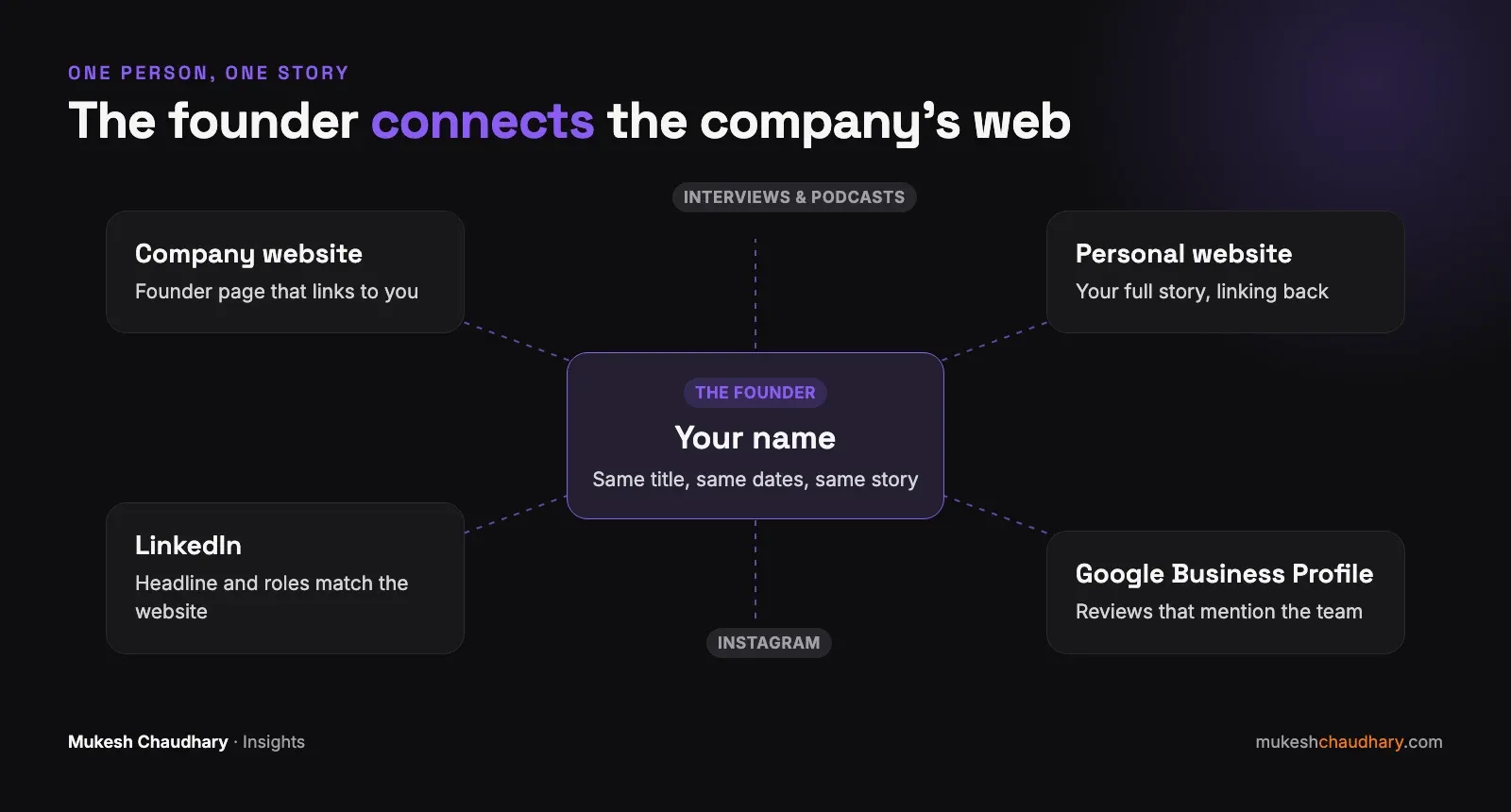
The goal is a small web of pages that all agree. In my case: my personal site, founder pages on both company websites, LinkedIn, and Instagram, each linking to the others and using the same words for the same facts.
Step 1: Fix your LinkedIn profile before you post anything
A founder’s profile does the quiet work every day, whether you post or not. Get these right first:
- Headline: your role and company exactly as written on the company website, then what you help people do. For me, that’s “Co-Founder & MD, Bizyocon”, followed by what I help businesses do.
- Experience: one entry per company, with the same title and start date as the company website. If your website says 2021, LinkedIn shouldn’t say 2020.
- Company page link: connect each experience entry to the company’s LinkedIn page, not plain text.
- Website link: add your company website, or your personal site if you have one.
- About section: open with one plain sentence that says who you are and what you do, the kind of sentence an AI tool could quote.
Then do the same in the other direction: your company website should have a founder or team page that links to your LinkedIn profile.
Step 2: Post about real work, not motivation
Founders struggle with posting because they think they need to sound like thought leaders. They don’t. The posts that work are the ones only you could write, because they come from your work.
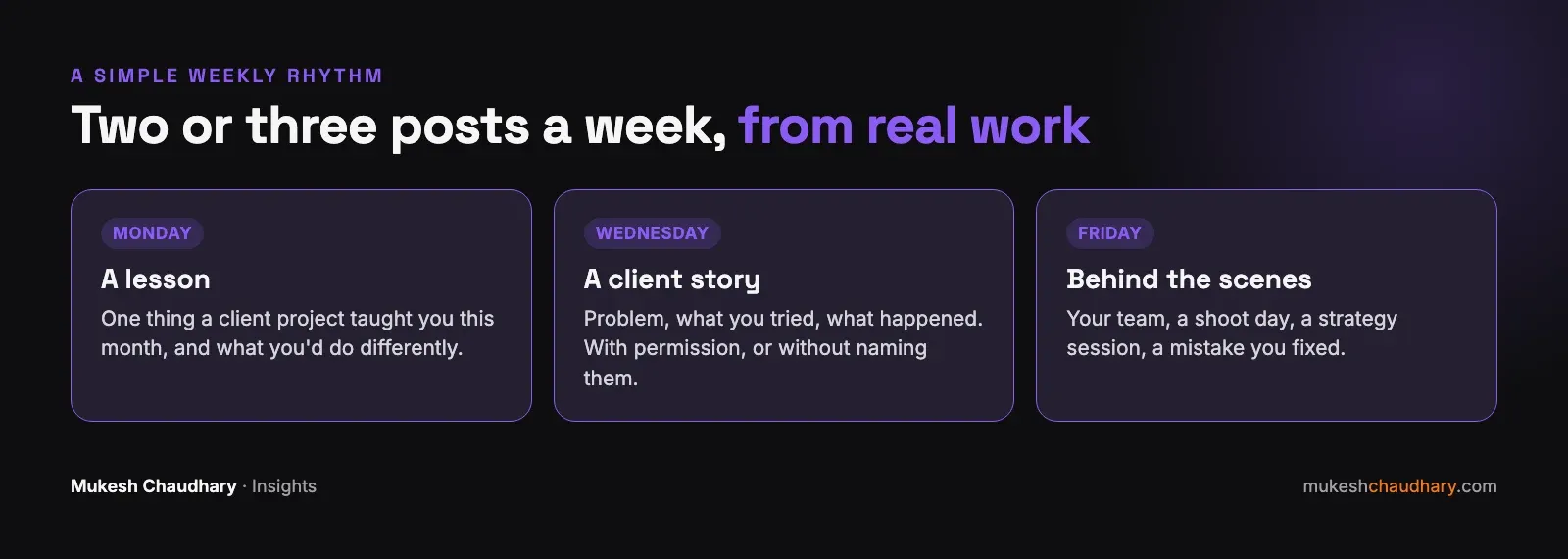
Ideas that come from everyday work:
- A lesson from a client project (with permission, or without naming them): what the problem was, what you tried, what happened.
- A decision and why you made it: a tool you dropped, a service you stopped offering, a price you changed.
- A mistake: what went wrong and what you changed. These often perform best because they’re honest.
- Behind the scenes: your team, your office, a shoot day, a strategy session.
- A clear opinion on your industry: something you disagree with and why.
Write the way your customers talk. For many of my clients in Gujarat, a mix of Hindi and English on LinkedIn and Instagram often feels more natural than formal English. Keep your website in clear English; that’s what search engines read best.
Step 3: Connect your posts to your website
LinkedIn posts don’t pass ranking power to your website. Their job is to build recognition and send people to search for you. Make it easy for them:
- Turn your best posts into longer articles on your website, where they can rank and be quoted by AI tools.
- Share your articles on LinkedIn with a short, native summary rather than just a link.
- Keep the facts identical. If a post says “600+ clients”, your website should say the same number.
What mistakes should founders avoid?
- Different titles on different platforms. “Founder” on LinkedIn, “Director” on the website, and “CEO” on Instagram look like three different people to a machine.
- Posting in bursts. Thirty posts in one month and then silence teaches your audience nothing. Two a week for a year works.
- Generic AI-written posts. People recognise them instantly. Use AI to tidy your words, not to replace your experience.
- Hiding the company. Your personal brand should point to your business, not compete with it.
Where to start this week
- Update your LinkedIn headline and experience to match your company website exactly.
- Check that your company website has a founder page linking to your profile.
- Write one post about a real client lesson from this month.
For the technical side, how search engines and AI tools read those pages, see how to get your business mentioned in ChatGPT and AI Overviews and the plain-English guide to llms.txt, schema, and AI crawlers.
If you’d like help building a founder brand that supports your business, let’s talk.