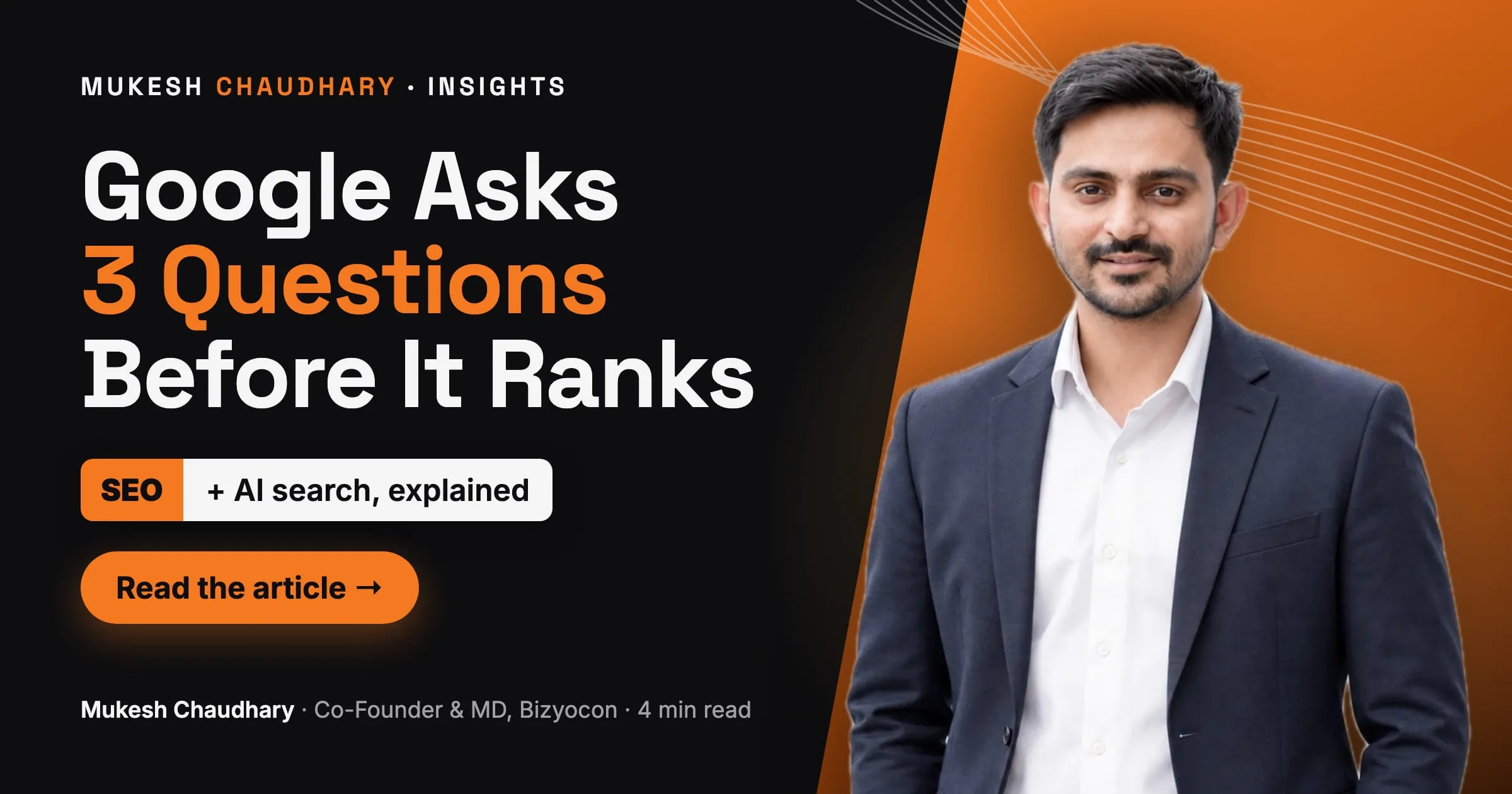
Google says it uses hundreds of signals to rank pages. Business owners don’t need to memorise any of them.
Every one of those signals is helping Google answer one of three questions about your page. If you can answer all three well, you’re ahead of most websites in your industry. I explain SEO to clients this way because it turns a mysterious black box into a checklist.
Question 1: Can Google read your page?
Before Google can rank a page, it has to find it, load it, and understand it. This is technical SEO, and it’s where many beautiful websites quietly fail.
Common problems I see:
- Content that only appears after JavaScript runs. Google can usually handle it, but many AI crawlers read only the raw HTML, so they see a blank page.
- Slow pages on mobile. Most of your customers are searching on a phone.
- No clear structure. One main heading (H1) per page, descriptive subheadings, and a sitemap help Google understand what each page is about.
- Pages blocked by mistake in robots.txt or with a “noindex” tag left over from development.
If Google can’t read the page properly, nothing else on this list matters.
Question 2: Does it answer what the person asked?
Google’s job is to answer the searcher’s question, so it looks for the page that best matches their intent: what they actually want.
Someone searching “digital marketing agency in Gandhinagar” wants a list of options and a way to contact one. Someone searching “how to increase Instagram reach” wants an explanation. Same industry, completely different pages.
What helps:
- Put the answer first. Answer the question in the first two or three sentences, then explain.
- One page, one main topic. Don’t make three pages compete for the same search.
- Write for the person, not the keyword. Repeating a keyword twenty times hasn’t worked for years.
- Target searches people actually make. Ranking first for a phrase nobody searches brings nobody. I wrote about this trap in Rank #1, zero calls.
Question 3: Can this page be trusted?
This is the question that has grown the most in importance.
Google describes good content using E-E-A-T: Experience, Expertise, Authoritativeness, and Trustworthiness. Its own guide to helpful content is direct about which one matters most: “Of these aspects, trust is most important” (Google Search Central).
Trust is built from signals like these:
- Real people and a real business behind the content: names, an about page, contact details.
- First-hand experience. Content that shows you’ve actually done the work, not repackaged what everyone else says.
- Consistent details everywhere. The same business name, address, and phone number on your website, Google Business Profile, and directories.
- Reviews and mentions from customers and other credible websites.
This is also why mass-produced content struggles. Google’s spam policies call out scaled content abuse: creating many pages mainly to manipulate rankings rather than help people (Google spam policies). The problem isn’t the tool used to write. It’s pages that add nothing new.
SEO is no longer ten blue links
When your customer has a question today, Google search is only one of the places they get an answer:
- Google search results, the classic list
- AI Overviews, the AI-written summary at the top of many Google searches
- ChatGPT, Perplexity, and other AI assistants
- Google Maps, for anything local
That’s why we now talk about AEO, Answer Engine Optimization, alongside SEO. AEO means making your content easy for these answer engines to understand and quote. In practice:
- Write clear, direct answers to the questions your customers ask.
- Add FAQ sections and structured data so machines can read your content’s meaning.
- Keep facts about your business identical everywhere they appear.
- Earn mentions on other trustworthy sites, because AI tools lean on sources that others already trust.
The good news: almost everything that helps AEO also helps traditional SEO. It’s the same three questions, just with more ways to be found.
Shortcuts versus systems
Picture two graphs.
The first is a shortcut strategy: bought links, copied content, keyword stuffing. Traffic shoots up fast. Then a Google core update arrives and it falls off a cliff.
The second is a system: a technically sound site, genuinely useful pages, and a growing reputation. Traffic rises slowly, then keeps rising, and core updates tend to help rather than hurt.
At Bizyocon we only build the second graph. It’s slower in the first few months and much stronger after that.
A 10-minute check for your website
Open your website on your phone and ask:
- Does each important page load quickly and show its content without waiting?
- Does each page have one clear main heading that says what it’s about?
- Does the first paragraph answer the question the page is meant to answer?
- Can a visitor see who is behind the business, with a real name, address, and phone number?
- Do those details match your Google Business Profile exactly?
- Is there at least one thing on the page that only your business could have written?
Every “no” is a ranking opportunity.
The bottom line
Google isn’t trying to trick you. It’s trying to send people to the most readable, most useful, and most trustworthy answer. Build your website around those three questions and you’re building for AI search at the same time.
Want an honest look at your website against these three questions? Book a free 30-minute consultation, or learn more about how I work with businesses.