
Meta has told advertisers that product browsing will be switched on for existing Facebook and Instagram ads on 28 October 2026, unless they opt out. If you run Meta ads for your business, or your agency does, decide before that date rather than finding out from your reports in November.
Here’s what the change is, what Meta has and hasn’t said, and how I’d decide for different kinds of businesses.
What is Meta’s product browsing?
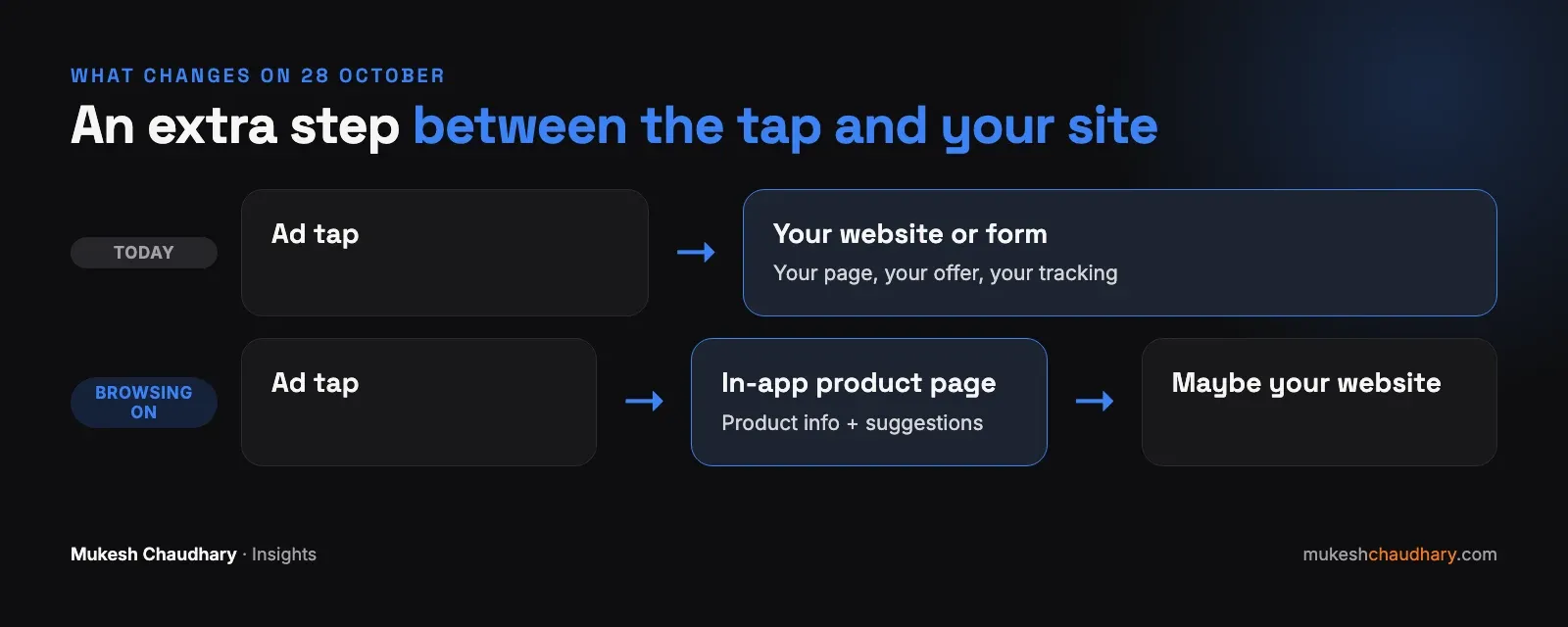
Product browsing is an existing Advantage+ creative enhancement. With it on, when someone taps your ad, Meta says they “may see an experience on Facebook or Instagram with product info and personalized suggestions”. In other words, an in-app product page can appear between the tap and your website.
Until now, advertisers could switch it on ad by ad. The change makes it the default for existing ads.
What exactly has Meta said?
According to the notice advertisers received in mid-October, and reported by industry sites:
- Product browsing will be added to existing ads on 28 October 2026 unless you use the “Opt out” button in the notice.
- You can change it any time per ad in the Advantage+ Creative and Destination settings.
- In a Meta experiment from 6 to 21 August 2026, covering about 117,700 advertisers in e-commerce, consumer goods, and retail, businesses saw “3% more conversions” on average.
What hasn’t Meta said?
As of mid-October, there was no Meta Help Center article or newsroom post explaining the change, so some important questions are open:
- Whether a product catalogue is required, and what the suggestions are based on.
- Which ad formats, objectives, and countries are included.
- Whether new ads created after 28 October will default to on.
- How the 3% was measured: which conversions, which attribution window, and what happened to cost per result and revenue.
When a platform changes a default without full documentation, the safe approach is to control the change yourself rather than let it happen to every campaign at once.
Should you opt out? A simple way to decide
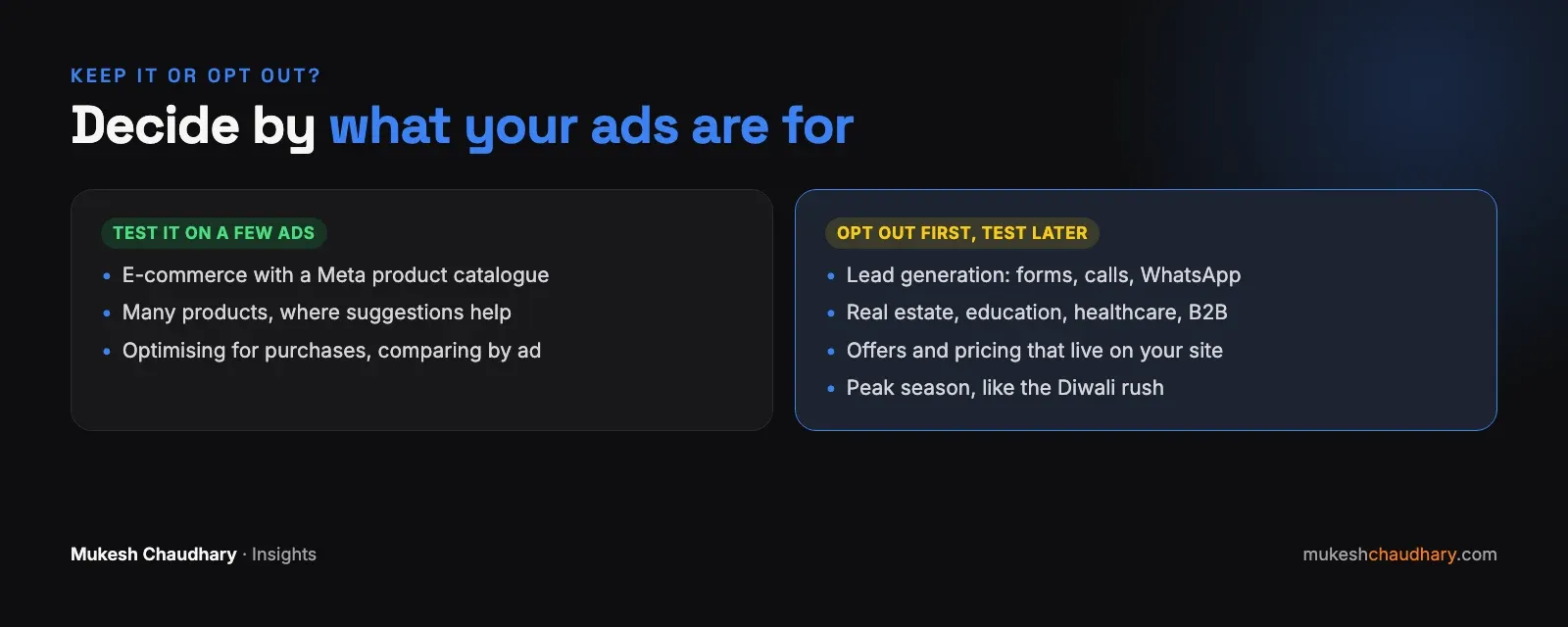
Consider testing it (on a few ads, not all):
- E-commerce stores with a product catalogue connected to Meta.
- Brands selling many products where browsing and suggestions help people choose.
- Advertisers optimising for purchases who can compare results by ad.
Consider opting out first, then testing separately:
- Lead-generation businesses: real estate, education, healthcare, B2B manufacturing, and services, where the goal is a form, call, or WhatsApp enquiry on your own site.
- Businesses whose pricing, offers, or bundles live on the website and can’t be shown properly in an in-app page.
- Advertisers mid-way through landing-page tests, where an extra step would muddy the results.
- Anyone in peak season who doesn’t want a platform default changing campaigns in the middle of the festive rush. In India, that’s right now, in the run-up to Diwali.
For most of the clients I work with, who are local businesses and manufacturers looking for enquiries rather than online checkouts, I’d opt out now and run a small, controlled test later.
How to opt out, step by step
- Before 28 October: find the notice Meta sent about product browsing and click its “Opt out” button. It isn’t clear whether this covers one ad account or several, so repeat it for every ad account you manage.
- At any time, per ad: edit the ad, open Advantage+ Creative (and the destination settings), and switch product browsing off.
- After 28 October: spot-check your highest-spending ads to confirm the setting, and check any new ads you create.
- Write it down: note the date, the account, and who changed it, so your team and your agency know.
How to test it properly if you keep it on
- Duplicate one ad: one with product browsing on, one off, same budget and audience.
- Run for at least 7–14 days before judging.
- Compare cost per result and revenue or lead quality, not just the number of “conversions” Meta reports.
- Check your own website and CRM numbers. If Meta reports more conversions but your sales or enquiries don’t move, trust your own data.
Platform defaults are designed to help the platform’s averages. Your job is to protect your own results. Spend ten minutes on this before 28 October.
If you’d like a second opinion on your Meta ad setup, book a free consultation.